Lead generation for founders and startup teams
Lead generation for founders: one card for investors, customers and hires
An early-stage founder is the sales team, the fundraiser and the recruiter. The same week holds an investor intro, three customer calls and a meetup where a future engineer might be standing by the coffee.
There is no time to run three systems. This guide sets up one card and a few placements that work for all three audiences, and a simple way to keep track of who is who.
Free to start: one card and one lead kit. No payment details needed.
- Sample lead 1 · “Get the product deck”Email signature
- Sample lead 2 · “Get the product deck”LinkedIn banner + link
- Sample lead 3 · “Get the product deck”Event badge
- Ericsson

- CIBC
- feeltop AG

- Sabarot

- Taylor Apartment Locator

- Archer Investors
- Nietz Sounds

In short
- One card with one button: book a demo, or ask for the deck.
- Put it where founders are already looked at: intro emails, LinkedIn and the conference badge.
- Think before putting sensitive material behind a public link.
- Follow up within a day, and record which of your three audiences each person belongs to.
Where leads start for founders and startup teams
A lead rarely begins on a form. It begins in one of a few everyday moments, and each of them needs a way for the other person to keep your details and leave theirs.
The warm intro
An adviser introduces you to an investor by email. The investor skims your reply and looks for a deck. If your signature has a button for it, you learn that they asked.
The profile check
Investors, customers and candidates all read your LinkedIn profile before they answer you. The Featured section is the first thing under your name.
The conference hallway
You meet dozens of people in two days and remember a handful. A badge they can scan, and a note written the same evening, is the difference between a network and a pile of names.
The demo call
Customer calls bring extra attendees you did not invite. A video background with a QR lets the quiet person from procurement save your details.
One pipeline: card, capture, contacts, follow-up
The four parts below are separate tools in most setups. Here they are one chain, and each link passes the next one what it needs.
- 1
Your digital card holds your details, your proof line and one clear offer: “Get the product deck”.
- 2
A visitor shares name and phone to get the offer. Email is optional. No app to install.
- 3
The request lands in Leads, tagged with the placement that brought it.
- 4
Call, message, WhatsApp or email from the contact page, then set a status.
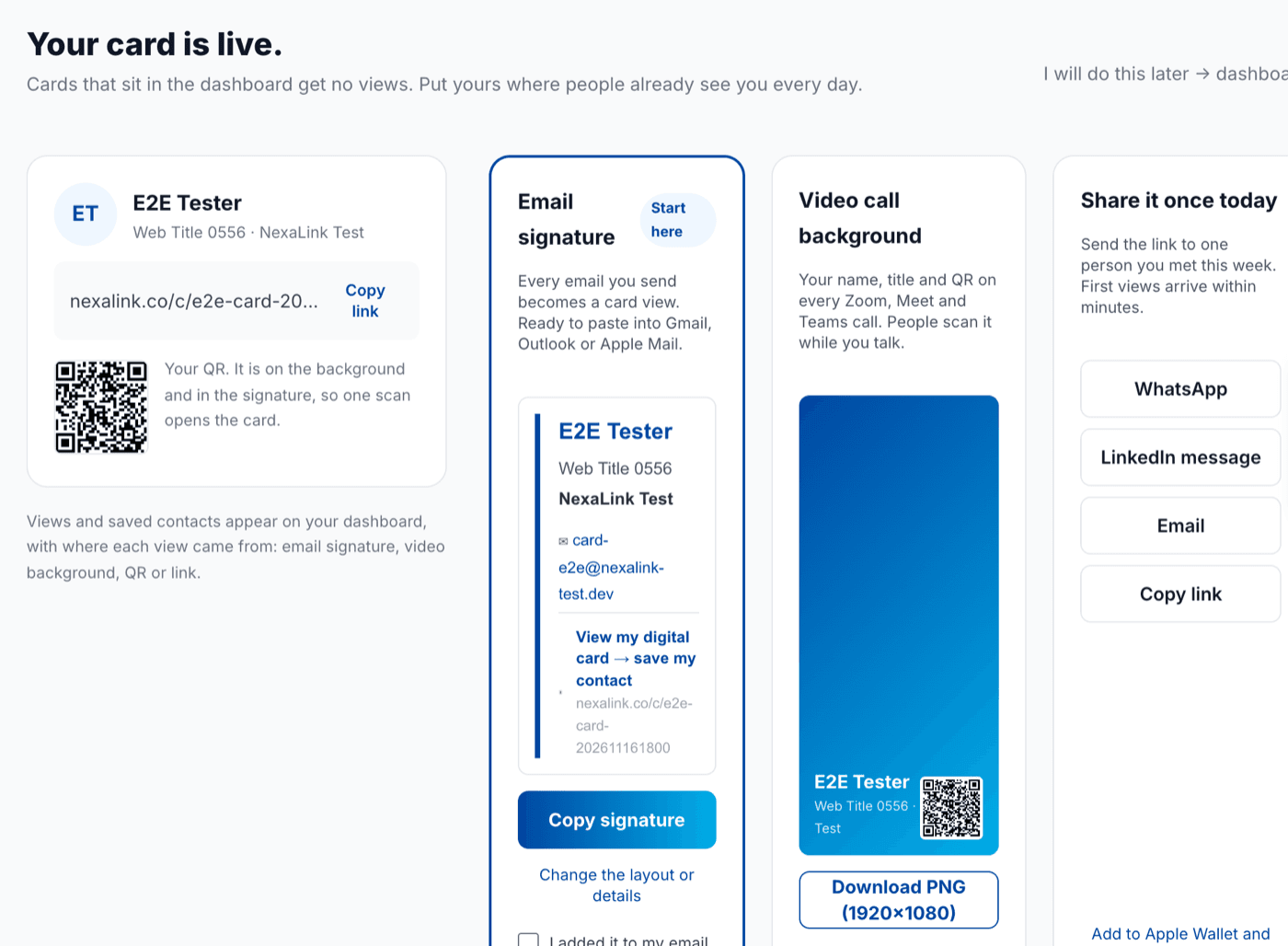
The digital business card for founders and startup teams
A founder's card should say what the company does in one sentence a stranger can repeat. That sentence does more work than any design choice.
Then give one action. Early on, that is usually a demo for customers. During a raise, it may be the deck.
More on the card itself: NexaLink Card · cards by profession
What to put on it
- Your name, role and the company in one plain sentence
- A proof line you can back up: customers, a launch, a certification
- The offer button: book a demo or get the deck
- A calendar link for people who are ready to talk
- Links to the product and to open roles
Lead capture: give people a reason to share details
Asking for a name and number before sending a deck is reasonable, and it tells you who is reading it. Customers get the product deck. Investors can be sent the fuller version once you have spoken.
Be deliberate about what sits behind a public link. Anyone with the link can ask for it, so keep financials and fundraising terms for a direct conversation.
In the lead kit the starting offer for founders and startup teams is “Get the product deck”. You add the link it opens. A visitor who wants it shares name and phone, the link opens right away, and the request appears in your Leads.
Offers that work in this trade
- The product deck or a one-page overview
- A recorded demo
- A pilot outline with scope and timeline
- A demo call on your calendar
The button can say “Book a demo” instead and open a link you choose, such as your calendar.
The lead kit: where to place your card, and what each placement brings
The lead kit turns one card into ten ready-made placements. Every link and QR carries its own source, so each lead shows where it came from. These are the placements that fit founders and startup teams best.
Under every intro, pitch and customer email
The compact signature layout keeps it to a few lines: your name, the company, one button and a QR. Intros get forwarded, and the button goes with them.
Shows in Leads as: Email signature
LinkedIn Featured, banner and Contact info
People who look you up get one tap to save your contact and ask for the deck. Add the card under Featured so it sits at the top of your profile.
Shows in Leads as: LinkedIn banner + link
On your lanyard at conferences and meetups
Add the event name and print the badge. People scan it in the hallway instead of typing your name into a phone.
Shows in Leads as: Event badge
Behind you on demo and investor calls
A background with your name, title and QR. Attendees you have not met can scan it during the call.
Shows in Leads as: Video-call background
All ten placements in the kit
- Email signature · Gmail · Outlook · Apple Mail
- Video-call background · Zoom · Meet · Teams
- QR kit · Table tent · Sticker · Desk stand
- LinkedIn banner + link · Banner · Featured · Contact info
- WhatsApp Business · Profile · Status · Quick reply
- Instagram bio + story · Bio link · Story · Highlight
- Wallet pass · Apple Wallet · Google Wallet
- Printable business card · QR on the back
- Event badge · Conferences · Meetups · Campus drives
- Google Business Profile · Website button · Weekly post
The email signature
Founders live in email, and much of it is forwarded: intros, updates, pilot proposals. A signature is the one part that survives every forward.
Keep it small. The banner line is useful for a launch or a milestone, and you can change it without touching the link or the QR.
Try it without an account: free email signature generator
| Emily Carter · Founder & CEO, Nexalink · +1 (415) 555-0134 | |
| Get the product deck → | View my digital card → save my contact | |
SOC 2 Type II · used by 600+ teams | |
| We're live on Product Hunt today. → | |
A landing page linked from your card
Before the company website is finished, or when it speaks to customers and you are talking to investors, a small page under your own name is useful.
Use Home for what you are building and the demo button, About for your background and the team, and Contact for the form.
What it is today: a small site with Home, About and Contact pages and a lead form, linked from your card, with visit and lead counts for you as the owner. It is an add-on for paid plans: anyone on a paid plan can build a draft, and publishing needs the add-on on the account.
Follow-up: what to do with each lead
Advice on timing varies, and a same-day note is rarely wrong. What matters more is that the message refers to the actual conversation.
Write a line in each contact's notes the evening you meet: investor, customer or candidate, and what they cared about.
In NexaLink each lead has a contact page with one-tap Message, WhatsApp, Call and Email, a notes timeline and a status (new, active, nurturing, dormant, lost). If you use Claude or ChatGPT, you can connect them to your contacts over MCP and ask for a draft.
Related: a lead follow-up system · follow-up email generator · MCP access
- Same evening
Add a note to every new contact and sort them: investor, customer, candidate.
- Within a day
Send a short, specific message. Mention what you discussed and attach or link the one thing they asked for.
- One week
Follow up once with something new: a metric, a customer story, a shipped feature. Not “just checking in”.
- Monthly
Investors who said “not yet” go to nurturing and get your update. Space it out. Frequent pings read as spam.
A worked example: one week of leads
Illustration, not a result
Imagine a founder with the compact signature, a LinkedIn Featured link and a printed badge for a two-day conference. The person and the leads below are made up to show how the pieces fit. Your numbers will differ.
What the week shows: one card served three audiences in a week. The tags say where people came from. The notes say who they are, which is the part a founder forgets by Monday.
Fair doubts
I already have a link-in-bio page.
Keep it for content. A card adds two things a link list does not: a contact people can save to their phone, and a way for them to leave their details.
Should the deck be behind a public link at all?
Use a product deck that you would be happy for a competitor to see. Share fundraising materials directly, after a conversation.
We are two people. Is this overkill?
It takes a few minutes and removes a recurring chore: finding the name of the person you met last week. That is worth it at any size.
Rules worth checking
Outreach email in the United States falls under the CAN-SPAM Act, which the FTC says makes no exception for business-to-business email. Identify yourself, include a postal address and honour opt-outs.
If you are raising money, take advice before publishing offering details. The SEC explains that an offering under Rule 506(c) may be broadly advertised only when all purchasers are accredited investors and the issuer takes reasonable steps to verify that. This is one more reason to keep fundraising terms off a public card.
This is general information, not legal advice. Rules differ by state and country, so check with your regulator or firm.
What is free and what is paid
- 1 digital card, 3 templates
- Up to 25 contacts
- One lead kit on your main card: the placements, your proof line and offer capture
- Views and leads for the last 30 days, as totals
- Your card carries NexaLink branding
- Up to 5 cards, unlimited contacts
- Lead capture form and NFC sharing
- Apple and Google Wallet passes
- Your own domain and custom link
- No NexaLink branding on your card
- See who viewed your card, 90 days of analytics
- Import and export contacts
- A lead kit on every card, with views and leads per placement
- Minimum 3 users
- Everything in Pro for every user
- Shared team directory and dashboard
- One brand template for every card
- CSV export and priority support
See all Card plans → · how pricing compares · NexaLink and other card apps
What customers say
I find NexaLink great for making lead capture easier for my business. I like their fast and professional service, especially the quick fixes to problems. Everything is good, and the initial setup was very easy.
Nexalink brings a genuinely innovative approach to digital business cards by combining networking with AI. What impressed me most is its MCP integration, which makes syncing and leveraging contact data across AI tools much more seamless and efficient. … They took the time to work with me personally to tailor the experience to my needs.
How to set it up
- 1Create your digital card
Add your name, role, contact details and your proof line. One card is free.
- 2Set the offer
Pick what a visitor gets for sharing name and phone. The preset for founders and startup teams is “Get the product deck”; add the link it should open.
- 3Put the first placement live
Under every intro, pitch and customer email. The compact signature layout keeps it to a few lines: your name, the company, one button and a QR. Intros get forwarded, and the button goes with them.
- 4Follow up from Leads
Each request appears in Leads with the placement that brought it. Call, message or email from the contact page and set its status.
Questions founders and startup teams ask
Should I link my pitch deck from my card or QR code?
Link a product deck you are comfortable sharing widely. Keep financials and fundraising terms for people you have spoken to, and send those directly.
What should a founder's email signature include?
Your name, role, company, one line on what it does, one button such as “Book a demo”, and a QR. Short is better.
How do I keep track of who I met at a conference?
Have people scan your badge so they land in your contacts, scan any paper cards with the app, and add a one-line note to each the same evening.
How soon should I follow up with an investor after an event?
Within a day is a safe choice. Refer to the conversation, send what they asked for and suggest a specific next step.
Can I use Claude or ChatGPT with my contacts?
Yes. NexaLink offers MCP access, so you can connect an assistant to your contacts and ask it to draft a follow-up or find who you met at an event.
Can my co-founder and first hires have cards too?
Yes. Each person can start free. The Team plan adds a shared directory, a dashboard and one brand template.
Build the founders pipeline once, then let it run
Create your card, set “Get the product deck”, and put the first placement live. It takes a few minutes and it is free to start.
Build my founders lead kitKeep reading
- The founders lead kit: assets and sample signature
- How a digital business card gets you leads
- How founders manage investor contacts
- Digital cards for investor pitches
- Following up after a conference
- Use NexaLink from Claude and ChatGPT
- A digital card and Linktree compared
Reviewed November 25, 2026. Plans and prices on this page are read from the same source as the pricing page.