Lead generation for salespeople and B2B teams
B2B sales lead generation that starts with the emails you already send
A rep sends dozens of emails a day, sits on video calls and gets looked up on LinkedIn before every meeting. Most of that attention goes nowhere, because there is nothing for the other person to do except reply.
This guide shows how to give each of those moments one small action, a card to save and a rate card to ask for, and how to follow up the people who take it.
Free to start: one card and one lead kit. No payment details needed.
- Sample lead 1 · “Get the rate card”Email signature
- Sample lead 2 · “Get the rate card”LinkedIn banner + link
- Sample lead 3 · “Get the rate card”Video-call background
- Ericsson

- CIBC

- feeltop AG
- Sabarot

- Taylor Apartment Locator
- Archer Investors
- Nietz Sounds

In short
- Put one card behind your email signature, LinkedIn profile and video-call background.
- Offer the thing buyers ask for anyway: the rate card, a spec sheet or a short call.
- Each request lands in Leads with the placement that brought it.
- Reply the same day, then follow a short, dated routine instead of chasing from memory.
Where leads start for salespeople and B2B teams
A lead rarely begins on a form. It begins in one of a few everyday moments, and each of them needs a way for the other person to keep your details and leave theirs.
The email thread
A prospect forwards your email to a colleague who was never on the call. Your signature is the only part of you that travels with it. If it holds a card and an offer, the colleague can reach you without asking for an introduction.
The profile check
Buyers look at your LinkedIn profile before a meeting. The banner and the website field are read by people who have not decided to talk to you yet, which makes them a good place for a low-pressure offer.
The video call
On a demo with five attendees you usually know two. A background with your name, title and a QR lets the other three save your details while you are still talking.
The trade show aisle
Booth conversations are short and badge scans miss many of them. A card on your phone and a QR on the table catch the visitors who stop for thirty seconds.
One pipeline: card, capture, contacts, follow-up
The four parts below are separate tools in most setups. Here they are one chain, and each link passes the next one what it needs.
- 1
Your digital card holds your details, your proof line and one clear offer: “Get the rate card”.
- 2
A visitor shares name and phone to get the offer. Email is optional. No app to install.
- 3
The request lands in Leads, tagged with the placement that brought it.
- 4
Call, message, WhatsApp or email from the contact page, then set a status.
The digital business card for salespeople and B2B teams
For a salesperson the card is a landing spot, not a brochure. A buyer who opens it should see who you are, what you sell in one line, and one button.
Keep it to the details a buyer needs to pass you along inside their company. Anything longer belongs in the rate card or the call.
More on the card itself: NexaLink Card · cards by profession
What to put on it
- Name, role and direct phone number
- One line on what you sell and for whom
- A proof line: years in business, customer count you can back up, a review rating
- The offer button: rate card, spec sheet or call
- A booking link if you run your own calendar
Lead capture: give people a reason to share details
Buyers do not fill in forms to be sold to. They do share a name and number to get something they were going to ask for in the next email anyway.
The rate card works because it is specific and useful on its own. A vague “learn more” does not.
In the lead kit the starting offer for salespeople and B2B teams is “Get the rate card”. You add the link it opens. A visitor who wants it shares name and phone, the link opens right away, and the request appears in your Leads.
Offers that work in this trade
- The current rate card or price list
- A one-page spec or comparison sheet
- A sample contract or onboarding checklist
- A 15-minute call on your calendar
The button can say “Book a 15-min call” instead and open a link you choose, such as your calendar.
The lead kit: where to place your card, and what each placement brings
The lead kit turns one card into ten ready-made placements. Every link and QR carries its own source, so each lead shows where it came from. These are the placements that fit salespeople and B2B teams best.
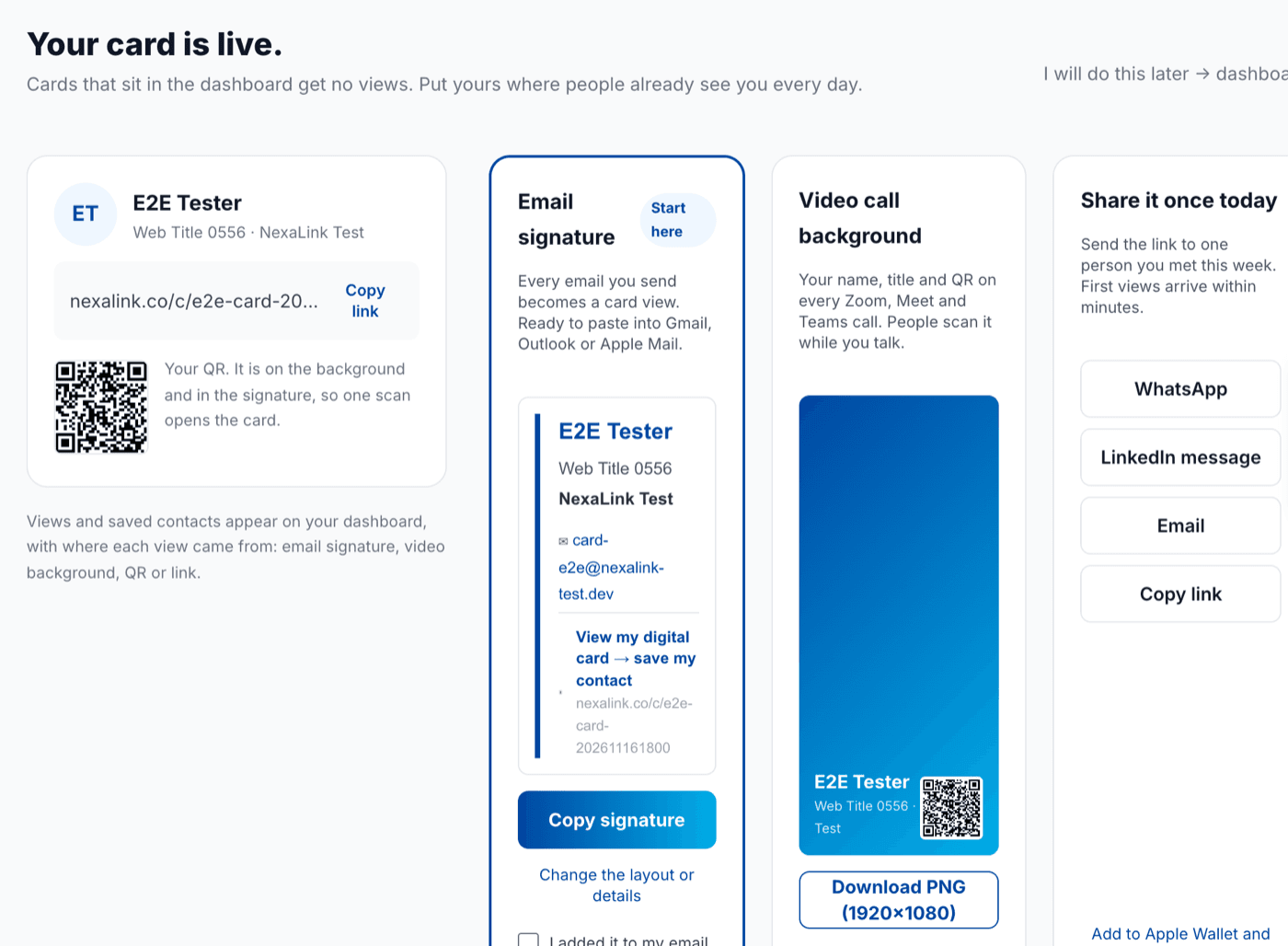
Under every email you send
The signature carries your card link, a small QR and the rate-card button. Replies, forwards and CCs all carry it, so people outside the original thread can ask for the rate card.
Shows in Leads as: Email signature
LinkedIn banner, Featured and Contact info
Upload the banner, add the card under Featured and paste the link in the Website field. People who check you before a meeting can save your contact in one tap.
Shows in Leads as: LinkedIn banner + link
Behind you on Zoom, Meet and Teams
A 1920×1080 background with your name, title and QR. Attendees you have never emailed can scan it during the call.
Shows in Leads as: Video-call background
On your lanyard at a trade show
Add the event name, print the badge and wear it. People scan it instead of asking for a paper card, and you scan theirs with the app.
Shows in Leads as: Event badge
All ten placements in the kit
- Email signature · Gmail · Outlook · Apple Mail
- Video-call background · Zoom · Meet · Teams
- QR kit · Table tent · Sticker · Desk stand
- LinkedIn banner + link · Banner · Featured · Contact info
- WhatsApp Business · Profile · Status · Quick reply
- Instagram bio + story · Bio link · Story · Highlight
- Wallet pass · Apple Wallet · Google Wallet
- Printable business card · QR on the back
- Event badge · Conferences · Meetups · Campus drives
- Google Business Profile · Website button · Weekly post
The email signature
The signature is the placement that works without any new habit. You paste it once and it rides along on every message.
For sales, keep the top line as your name and role, add one proof line, and let the button say exactly what the reader gets. The QR helps when your email is read on a desktop and saved from a phone.
Try it without an account: free email signature generator
EC | Emily Carter Head of Sales · Northwind Logistics +1 (415) 555-0134 · emily@northwindlogistics.com · northwindlogistics.com 4.8 ★ on G2 · 64 reviews Moving freight for 200+ brands since 2011 | ||
| |||
| Q1 freight slots are filling up. Lock your rate before Jan 31. → | |||
A landing page linked from your card
Some buyers want more than a card before they share a number. A small landing page gives them a place to read what you do, who you work with and how to reach you.
For sales, keep Home to the offer and a short proof line, use About for the company and the territory you cover, and let Contact carry the lead form.
What it is today: a small site with Home, About and Contact pages and a lead form, linked from your card, with visit and lead counts for you as the owner. It is an add-on for paid plans: anyone on a paid plan can build a draft, and publishing needs the add-on on the account.
Follow-up: what to do with each lead
A rate-card request is a warm signal, and it cools quickly. The routine below is short on purpose so that it actually gets done.
Write one line in the contact's notes after each touch. Three weeks later it is the only way to remember what was said.
In NexaLink each lead has a contact page with one-tap Message, WhatsApp, Call and Email, a notes timeline and a status (new, active, nurturing, dormant, lost). If you use Claude or ChatGPT, you can connect them to your contacts over MCP and ask for a draft.
Related: a lead follow-up system · follow-up email generator · MCP access
- Same day
Reply on the channel they used. Confirm they got the rate card and ask one question about volume or timing.
- Day 2
If the request came from a forwarded email, ask who else is involved and offer a short call for the group.
- Day 5
Send one useful thing: a relevant example or a clear answer to the question most buyers ask at this stage.
- Day 14
One last check-in with an easy way out. Set the status to nurturing or lost so your list stays honest.
A worked example: one week of leads
Illustration, not a result
Imagine a rep at a freight company who has pasted the signature, set the LinkedIn link and uses the video background. The person and the leads below are made up to show how the pieces fit. Your numbers will differ.
What the week shows: none of these people filled in a form on a website. They came from messages and meetings that were happening anyway, and the source tag says which placement to keep doing.
Fair doubts
My company already gives me a signature.
Then keep it. Ask whether you may add a card link under it, or use the card on LinkedIn and video calls instead. One placement is enough to start.
We have a CRM. Why another list?
The card is the capture step that comes before the CRM. On paid plans you can export contacts and connect a CRM. On the free plan, treat Leads as the inbox you clear into your CRM by hand.
Will a buyer really type a phone number?
Some will not, and that is fine: they can still save your contact. The ones who do are telling you they want the rate card now.
Rules worth checking
In the United States the CAN-SPAM Act covers commercial email, and the FTC states that it makes no exception for business-to-business email. Follow-up emails need an accurate sender, a postal address and a working way to opt out.
In the United Kingdom the ICO notes that data protection law applies to named business contacts once their details are stored, even when they act in a business capacity.
This is general information, not legal advice. Rules differ by state and country, so check with your regulator or firm.
What is free and what is paid
- 1 digital card, 3 templates
- Up to 25 contacts
- One lead kit on your main card: the placements, your proof line and offer capture
- Views and leads for the last 30 days, as totals
- Your card carries NexaLink branding
- Up to 5 cards, unlimited contacts
- Lead capture form and NFC sharing
- Apple and Google Wallet passes
- Your own domain and custom link
- No NexaLink branding on your card
- See who viewed your card, 90 days of analytics
- Import and export contacts
- A lead kit on every card, with views and leads per placement
- Minimum 3 users
- Everything in Pro for every user
- Shared team directory and dashboard
- One brand template for every card
- CSV export and priority support
See all Card plans → · how pricing compares · NexaLink and other card apps
What customers say
I find NexaLink great for making lead capture easier for my business. I like their fast and professional service, especially the quick fixes to problems. Everything is good, and the initial setup was very easy.
Nexalink brings a genuinely innovative approach to digital business cards by combining networking with AI. What impressed me most is its MCP integration, which makes syncing and leveraging contact data across AI tools much more seamless and efficient. … They took the time to work with me personally to tailor the experience to my needs.
How to set it up
- 1Create your digital card
Add your name, role, contact details and your proof line. One card is free.
- 2Set the offer
Pick what a visitor gets for sharing name and phone. The preset for salespeople and B2B teams is “Get the rate card”; add the link it should open.
- 3Put the first placement live
Under every email you send. The signature carries your card link, a small QR and the rate-card button. Replies, forwards and CCs all carry it, so people outside the original thread can ask for the rate card.
- 4Follow up from Leads
Each request appears in Leads with the placement that brought it. Call, message or email from the contact page and set its status.
Questions salespeople and B2B teams ask
Can I put my digital business card in my email signature?
Yes. The lead kit builds a signature with your card link, a small QR and your offer button. You copy it once and paste it into Gmail, Outlook or Apple Mail.
Do recipients need an app to save my card?
No. The card opens in a browser. They can save your contact or ask for the rate card without installing anything.
How do I know where a lead came from?
Each placement has its own source. A lead from your signature is tagged Email signature, one from your banner is tagged LinkedIn banner + link, and so on. The tag shows the placement, not the individual email.
How soon should I follow up a trade show lead?
The same day if you can, while the conversation is fresh for both of you. Write a note on the contact before you leave the hall so the follow-up can mention what you discussed.
Can I scan the paper cards I collect?
Yes. The NexaLink Card app for iPhone and Android scans a paper card or badge into a contact, so the people who hand you paper end up in the same list.
What happens to my card if I change jobs?
The card belongs to your account. Edit the company, title and contact details, and the same link and QR open the updated card. Copy the signature again so the text in your emails matches.
Build the sales pipeline once, then let it run
Create your card, set “Get the rate card”, and put the first placement live. It takes a few minutes and it is free to start.
Build my sales lead kitKeep reading
- The sales lead kit: assets and sample signature
- How a digital business card gets you leads
- How salespeople track leads after events
- Digital business cards for account executives
- Digital cards for sales prospecting
- NexaLink for trade shows
- NexaLink as a Popl alternative
Reviewed November 25, 2026. Plans and prices on this page are read from the same source as the pricing page.